Air filter replacement - engine and cabin filters
Engine and cabin air filters cost $10-$25 each, take 2-10 minutes to install, and require no tools on most vehicles built after 2000. Shops charge $40-$95 in labor for the same job per RepairPal's 2026 cost estimator. The engine air filter sits in a black plastic airbox under the hood; the cabin air filter sits behind the glove box. If you can open a glove box and pop two spring clips, you can change both filters in the time it takes to wait for your coffee to brew.
How Much Does Air Filter Replacement Cost?
Engine air filter replacement runs $40-$75 at an independent shop and $70-$150 at a dealership, per RepairPal's 2026 national average. Cabin air filter replacement runs $50-$95 at an independent shop and $80-$170 at a dealership. The filters themselves cost $10-$25 each at AutoZone, O'Reilly, RockAuto, or Amazon. That means shops are charging $15-$70 in labor for a 2-minute swap on the engine filter and a 5-10 minute swap on the cabin filter. The markup is the highest of any common maintenance item.
| Service | Independent Shop | Dealership | DIY (Parts Only) | DIY Time |
|---|---|---|---|---|
| Engine air filter | $40-$75 | $70-$150 | $10-$25 | 2 min |
| Cabin air filter | $50-$95 | $80-$170 | $12-$25 | 5-10 min |
| Both filters | $85-$160 | $140-$300 | $22-$50 | 7-12 min |
Sources: RepairPal 2026 cost estimators; verified pricing at AutoZone, O'Reilly, and RockAuto for top 30 U.S. vehicles, June 2026.
For a 2024 Toyota Camry 2.5L, both filters cost about $35 in parts: engine filter 17801-25040 at $18 (Toyota OEM) or $11 (Fram CA10755), plus cabin filter 87139-30040 at $19 (Toyota OEM) or $13 (Bosch 6055C). The same job at a Toyota dealer runs $140-$220 total. DIY saves $105-$185 and takes about 10 minutes including locating the parts.
The cheapest place to buy filters is RockAuto.com for OEM-equivalent brands (Fram, Wix, Mann-Filter, Bosch). AutoZone and O'Reilly are 20-40% more expensive but offer free curbside install on engine air filters with purchase — useful if you'd rather not pop the airbox yourself. Amazon and Walmart are competitive on aftermarket brands but check the part number against your owner's manual before ordering, since Amazon listings sometimes mismatch fitment.
How Often Should You Replace Engine and Cabin Air Filters?
Replace the engine air filter every 15,000-30,000 miles and the cabin air filter every 15,000-25,000 miles or annually. Manufacturers split the schedule into "normal" and "severe" service — severe means dusty roads, frequent short trips, stop-and-go traffic, or extreme temperatures. Toyota's 2024 Camry owner's manual specifies inspection of the engine air filter every 30,000 miles under normal service and replacement at 15,000 miles under severe. Honda's Maintenance Minder flags the engine air filter around 30,000 miles for the Civic. Ford's F-150 schedule calls for the engine air filter every 30,000 miles and the cabin filter every 20,000.
Cabin filter intervals are shorter because the filter handles a higher volume of air relative to its size and faces real-world contaminants — pollen, soot, brake dust, and the occasional acorn. Drivers in Los Angeles, Phoenix, Houston, or anywhere with high pollen counts in spring should default to the 15,000-mile (or yearly) end of the range. Drivers in rural northern climates with clean rural air can sometimes stretch cabin filters to 25,000 miles without issue. Pull the filter and look at it — if it's gray instead of white and full of debris, replace it.
Pinion uses your VIN to load the manufacturer's air filter replacement schedule for your specific vehicle and sends a push reminder when your mileage approaches the due date for either filter. The reminder includes the OEM part number, so you can order the right filter without digging through the manual.
Severe Service: When the Shorter Interval Applies
You are on the severe service schedule if any of the following apply: you live or commute on dirt or gravel roads, you regularly drive in construction zones, your daily commute is under 5 miles (short trips), you tow regularly, or you live somewhere with frequent dust storms (Phoenix, Albuquerque, West Texas). On the severe schedule, most manufacturers cut the engine air filter interval in half — 15,000 miles instead of 30,000. The full car maintenance schedule covers which other items shift on the severe schedule.
Engine vs. Cabin Air Filter: What's the Difference?
The engine air filter cleans the air going into the engine for combustion. The cabin air filter cleans the air coming into the passenger compartment through the HVAC system. They are entirely separate parts in different locations doing different jobs. A dirty engine filter can hurt acceleration and protect a $300 mass airflow sensor. A dirty cabin filter affects you — making the AC weak, the heater slow, and the air you breathe dirtier.
Both filters are paper or synthetic media in a rectangular frame, and they look similar enough that DIY mechanics occasionally try to put one in the other's slot. They are not interchangeable. The engine filter is bigger (typically 9-12 inches per side) and has a stiff plastic frame. The cabin filter is thinner with a softer frame and includes activated carbon for odor filtration on roughly 40% of OEM cabin filters.
If you only replace one filter, replace the cabin filter. The engine air filter protects the engine, but the engine computer adapts to a clogged filter and won't strand you. The cabin filter directly affects what you breathe and how hard the blower motor works — neglecting it for 50,000+ miles can burn out the blower ($150-$400 to replace) and turn your cabin into a pollen trap.
How to Replace an Engine Air Filter (2 Minutes)
The engine air filter sits in a black plastic airbox in the engine bay, usually near the front fender on the passenger or driver side. The box has a large flexible hose running from it to the throttle body — that's the intake tract. Open the airbox lid (almost always held by 2-4 metal spring clips), pull the old filter out, drop the new one in matching the airflow arrow, and close the lid. The job is faster than reading this paragraph.
Tools
- The new engine air filter (correct part number for your vehicle)
- A Phillips screwdriver if your airbox uses screws instead of clips — uncommon on post-2010 vehicles
- A shop vacuum or rag (optional — useful for sucking out leaves or debris that collected in the airbox)
Step by Step
1. Pop the hood and locate the airbox. It's a black plastic rectangle, roughly the size of a shoebox, with a 3-4 inch corrugated hose leaving one side. On a 2024 Honda CR-V, it's on the passenger side near the strut tower. On a 2023 Ford F-150, it's on the driver side. On a 2025 Toyota Camry, it's on the passenger side front.
2. Release the clips or screws. Most modern airboxes use 2-4 metal spring clips on the lid. Lift each clip with your fingernail or a flat screwdriver — they snap up easily. If the box uses screws, they're Phillips, almost always #2 size.
3. Lift the lid and check the old filter's orientation. The lid hinges back or lifts completely off. Look at the old filter for a printed airflow arrow on the side of the frame. It will say something like "AIR FLOW →" pointing toward the throttle body side.
4. Pull the old filter out and inspect the airbox. If you find leaves, mouse nests, or significant dust, vacuum it out. Wipe the sealing surface where the lid meets the box with a rag so the new filter seats properly.
5. Drop in the new filter. Match the airflow arrow direction. The filter should sit flush in the box with the rubber gasket lining up against the sealing surface.
6. Close the lid and re-clip. Make sure the lid lines up flat — if a clip won't close easily, the filter probably isn't seated or the lid is slightly cocked. Force is never required.
The first time you do this it takes 5 minutes because you're learning where things are. The second time it takes 90 seconds.
How to Replace a Cabin Air Filter (5-10 Minutes)
The cabin air filter on 90% of post-2005 vehicles sits in a slot behind the glove box. Empty the glove box, squeeze the side tabs to drop the box down past its normal open stops, pop off the plastic filter housing cover behind it, slide the old filter out, slide the new one in matching the airflow arrow, reassemble. No tools needed on most cars. A few outliers — BMW 3-Series (E90/F30), pre-2010 Mercedes E-Class (W211), Ford F-250/F-350 Super Duty (2008-2016) — hide the filter under the hood in the cowl area at the base of the windshield, which adds 5 minutes for cowl panel removal.
Step by Step
1. Empty the glove box. Everything — registration, snacks, that flashlight you forgot you had. The glove box needs to drop further than its open position.
2. Drop the glove box. Look at the inside walls of the glove box near the hinges. Most have small plastic tabs (Toyota, Honda), hooked stops on cables (Ford, GM), or a damper arm that needs to be unhooked (Hyundai Tucson, Kia Sportage). Squeeze the box walls inward to clear the stops and let it hang. The dashboard manual explains the specific release mechanism for your car if it's not obvious.
3. Remove the cabin filter housing cover. Behind the glove box you'll see a plastic cover, usually about 8 inches wide, held by 2 plastic tabs or a small latch. Squeeze and pull the cover off.
4. Pull out the old filter. It slides out horizontally. Expect dust, pollen, leaves, and occasionally a startled spider. Note the airflow arrow direction printed on the side of the frame — usually pointing down toward the blower motor.
5. Slide in the new filter. Match the airflow arrow. The filter should slide all the way in until it stops. If it goes in crooked, it will tear when the blower runs.
6. Reassemble. Snap the housing cover back into place, lift the glove box back into its normal position (the tabs re-engage with light pressure), and reload everything you removed.
7. Test. Start the engine, set the HVAC to fresh air (not recirculate), and crank the fan to max. Airflow should be noticeably stronger if the old filter was clogged.
Premium cabin air filters with activated carbon (Bosch HEPA, FRAM Fresh Breeze, K&N VF-series) cost $4-$10 more than standard filters and remove odors from exhaust, smog, and brake dust. They are worth the upgrade if you commute through traffic, have allergies, or drive in a city. On a 2024 Honda CR-V, the standard cabin filter (80292-T0G-A02) costs $14; the FRAM Fresh Breeze CF10743 with arm and hammer baking soda is about $22.
Signs Your Air Filters Need Replacement
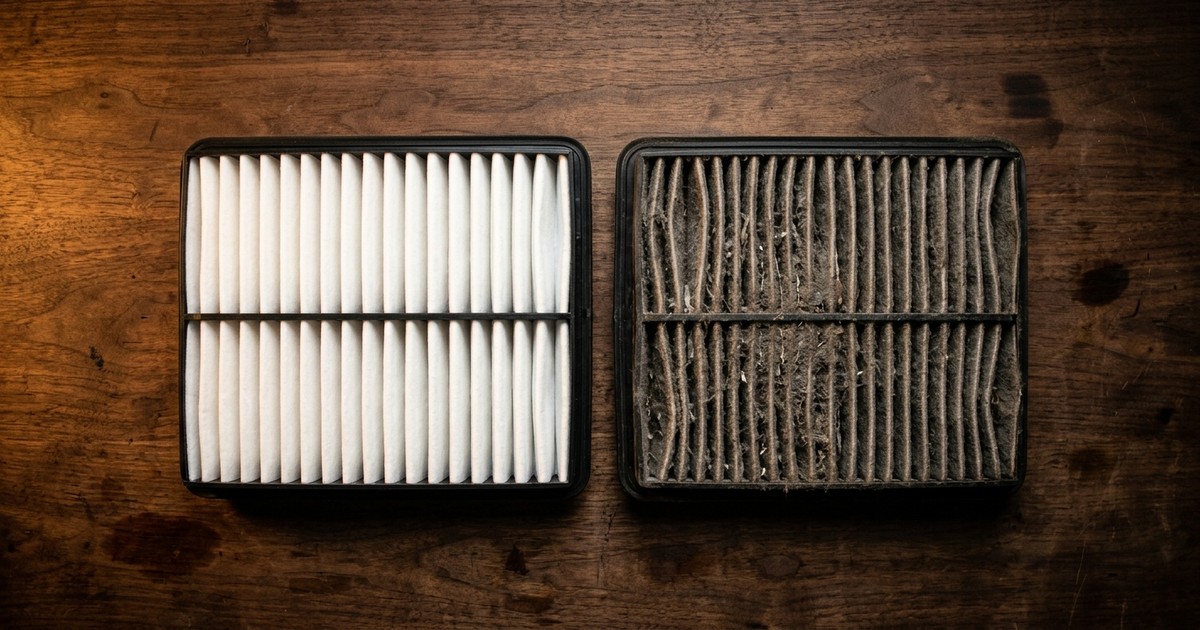
The clearest sign for either filter is visual. Pull the filter out, hold it up to light — if you can see through the pleats, it's still good. If the pleats are dark gray to black and packed with debris, it's overdue. For a more functional test, your engine air filter is overdue when you notice reduced throttle response from a stop, occasional rough idle, or your fuel trims drifting in an OBD2 scanner. Your cabin filter is overdue when the AC blows weaker than it used to, the windshield takes longer to defog, or you smell musty odors when the fan first turns on.
Visual inspection is fast and free — you're already in the airbox or behind the glove box when you check. Replace any filter that looks meaningfully darker than a new one. If you're unsure, hold the new filter next to the old one in daylight. The contrast usually settles it. A 30,000-mile engine air filter on a daily commuter typically looks dingy gray; a 50,000-mile cabin filter looks black with embedded leaf bits. Both should have been changed earlier.
A Clogged Filter Doesn't Always Trigger a Code
The engine computer adapts to a slowly clogging filter by adjusting fuel trim. You won't get a check engine light from a dirty air filter alone — only from secondary damage (a contaminated mass airflow sensor reads incorrectly and throws codes P0101 or P0171, for example). The check engine light is not your air filter monitor. Mileage and visual inspection are. If your CEL is on and the air filter is overdue, the filter is rarely the root cause but a contributing factor in about 15-20% of MAF-related codes — replace it along with whatever the scan tool points to.
Should You Pay a Shop to Change Your Air Filters?
No. Air filter replacement is the lowest-skill, highest-markup item in the entire maintenance menu. The shop's labor charge for engine air filter replacement is $15-$50 for a job that takes them 90 seconds with the same hand motions you'd use. Cabin filter labor runs $30-$70 for a 5-10 minute glove-box operation. Quick-lube chains like Jiffy Lube and Valvoline Instant Oil Change frequently upsell both filters during oil changes at markups of 200-400% over retail parts pricing.
The only legitimate exceptions: vehicles where the cabin filter location is unusually difficult (pre-2010 BMW 3-Series E90 and 5-Series E60 requiring dashboard partial disassembly), drivers with limited mobility or no tools, or anyone who can't lift the hood safely. For everyone else, this is the easiest 10 minutes of savings in car maintenance — typically $50-$100 saved per service interval, or $200-$400 over the life of the car. Bundling the filter swap with your next oil change (which is also DIY-friendly on most 4-cylinder and V6 vehicles, see our how often to change oil guide) makes the trip to the parts store even more efficient.
The DIY math: filter parts cost $22-$50 for both filters. Shop labor adds $40-$95. Annual savings are $40-$95 if you do both filters once a year. Across a 10-year ownership period that's $400-$950 — for a job that takes 7-12 minutes once you've done it once. Air filter replacement has the highest savings-per-minute ratio of any DIY car maintenance task.
Air filter replacement is one item in your vehicle's broader car maintenance schedule. When the filter is due, check whether your spark plugs or timing belt interval is approaching at the same mileage — bundling services saves trips. The 30-point car maintenance checklist lists the rest of what should be inspected at each service. For symptoms that don't go away after filter replacement, the car diagnostic guide walks through how to narrow down what else might be wrong.
Frequently Asked Questions
Vlad Kuzin
Developer of Pinion. Writes about car maintenance to help people save money and stay safe on the road.