Car Maintenance Schedule: What to Do and When (2026)

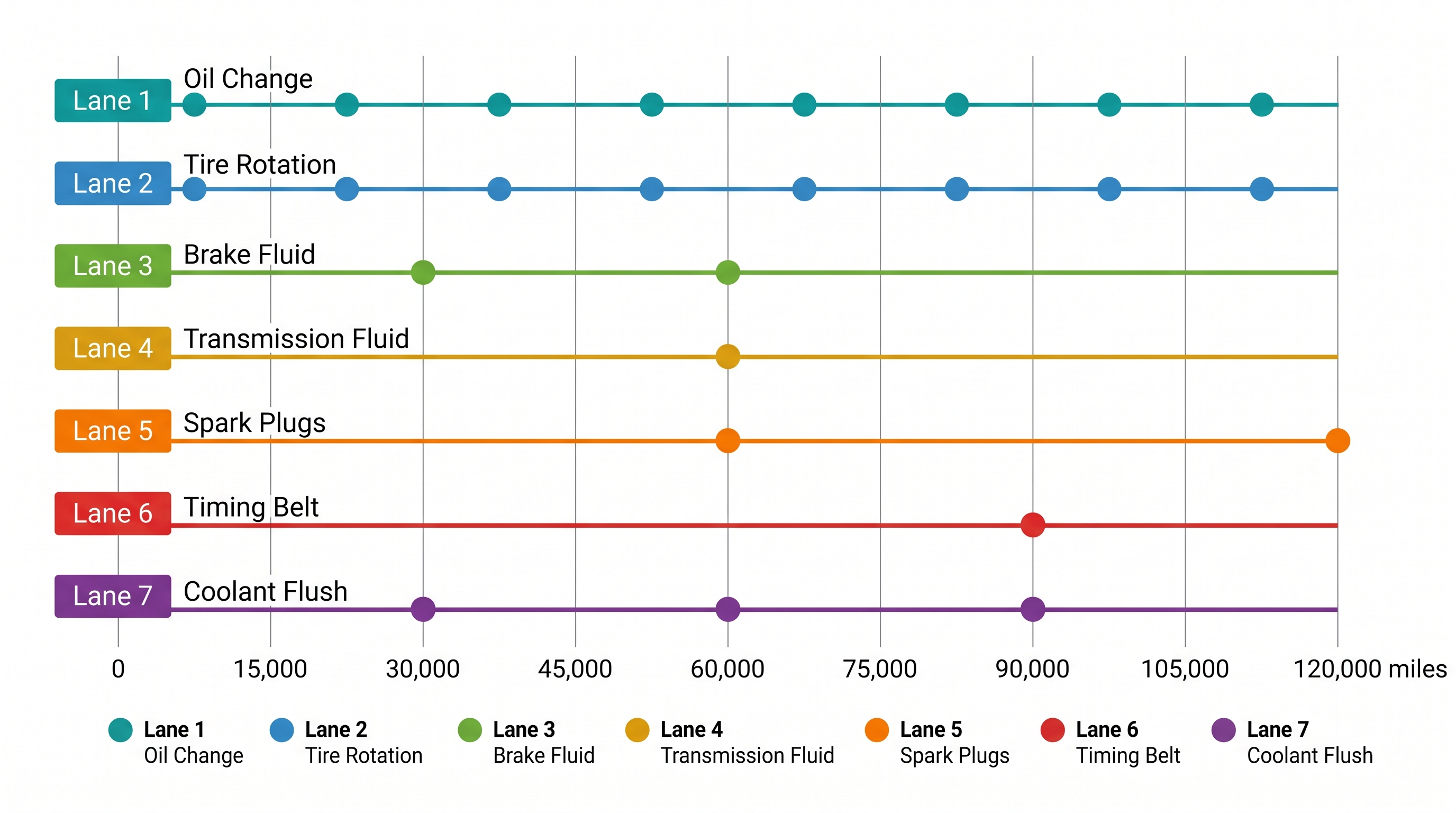
A car maintenance schedule tells you exactly which services to perform at which mileage intervals — oil changes every 5,000-10,000 miles, brake fluid every 30,000-45,000 miles, spark plugs at 60,000-100,000 miles, and so on. Every manufacturer publishes two schedules in the owner's manual: one for normal driving and one for severe conditions. Most drivers qualify for the severe schedule without knowing it.
AAA's 2025 study puts the average cost of maintenance, repairs, and tires at 11.04 cents per mile — $1,656 per year at 15,000 miles. Following the correct schedule is the difference between predictable $200 oil changes and surprise $4,000 transmission rebuilds.
The Complete Maintenance Schedule by Mileage
Every vehicle's schedule varies, but the table below covers the services that apply to the vast majority of gasoline-powered cars and trucks. Use your owner's manual for exact intervals — this table gives you the baseline.
| Service | Normal Schedule | Severe Schedule | Avg. Cost (Shop) |
|---|---|---|---|
| Oil & filter change | 7,500-10,000 mi | 5,000-7,500 mi | $65-$125 (synthetic) |
| Tire rotation | 5,000-7,500 mi | 5,000 mi | $25-$50 |
| Cabin air filter | 15,000-20,000 mi | 15,000 mi | $95 |
| Engine air filter | 15,000-30,000 mi | 15,000 mi | $83 |
| Brake inspection | 15,000-20,000 mi | 10,000-15,000 mi | Free-$50 |
| Brake fluid flush | 30,000-45,000 mi | 24,000-30,000 mi | $80-$150 |
| Transmission fluid | 60,000-100,000 mi | 30,000-60,000 mi | $150-$250 |
| Coolant flush | 60,000-100,000 mi | 30,000-60,000 mi | $131-$209 |
| Spark plugs | 60,000-100,000 mi | 60,000-80,000 mi | $80-$300 |
| Serpentine belt | 60,000-100,000 mi | 50,000-80,000 mi | $100-$200 |
| Timing belt (if equipped) | 60,000-100,000 mi | 60,000-80,000 mi | $884-$1,284 |
| Wheel alignment | As needed / annually | As needed / annually | $100-$175 |
| Battery replacement | 4-5 years | 3-4 years | $414 |
The single most important thing you can do is check your owner's manual for your vehicle's specific schedule. A 2026 Toyota Camry on 0W-20 synthetic has a 10,000-mile oil change interval under normal conditions and 5,000 miles under severe conditions. A 2018 Chevy Silverado on conventional oil may require changes every 5,000 miles regardless. The table above is a starting point — your manual is the final word.
Normal vs. Severe: Which Schedule Applies to You
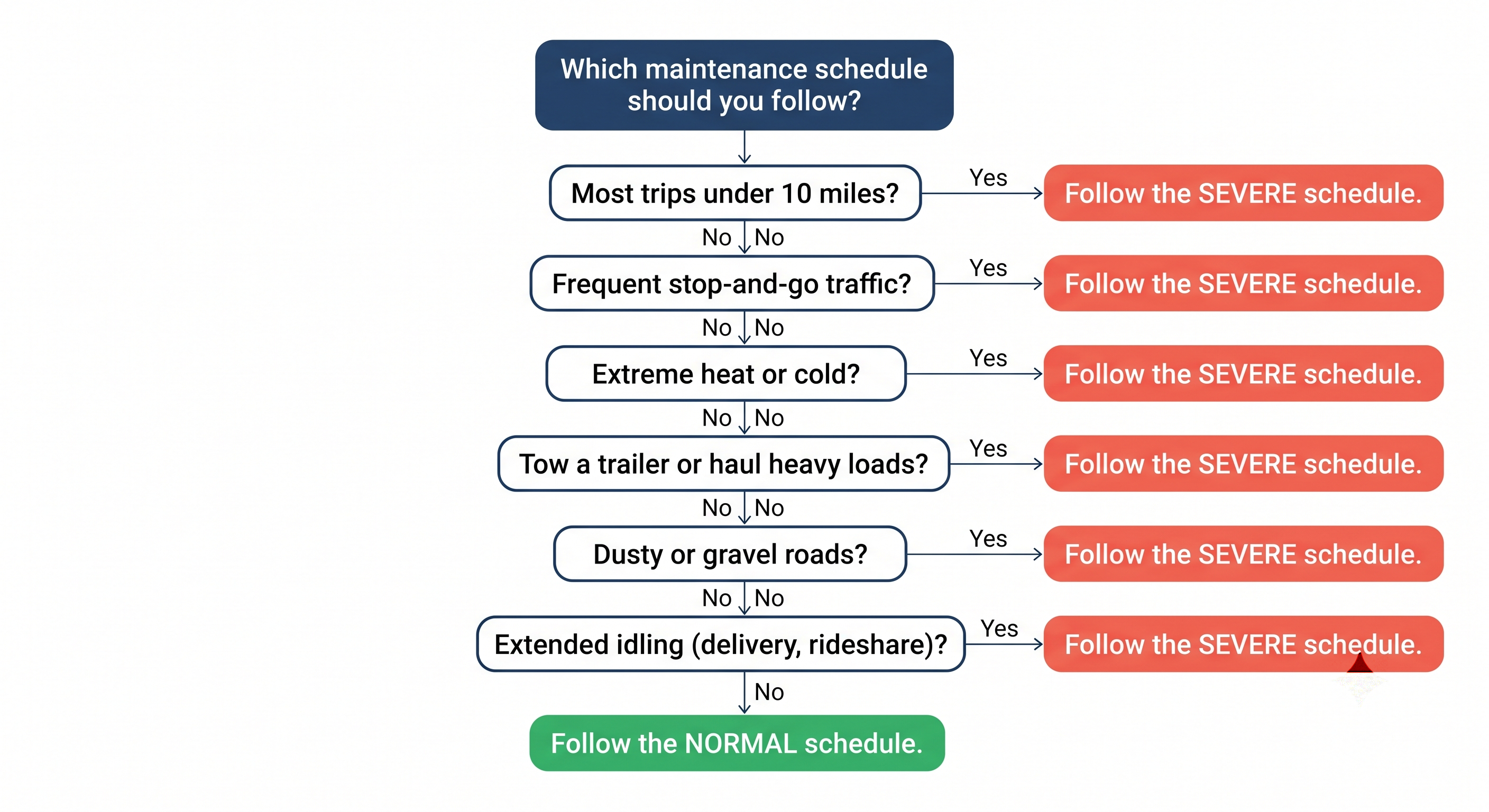
Manufacturers publish two maintenance schedules because driving conditions dramatically affect how fast fluids break down and components wear. The severe schedule cuts most intervals by 30-50%. The catch: most drivers qualify for severe and don't realize it.
Toyota's Severe Criteria
Toyota specifies the severe schedule if your driving regularly includes any of the following:
- Short trips under 5 miles, especially in cold weather (the engine never reaches full operating temperature, allowing fuel and moisture to contaminate the oil)
- Stop-and-go traffic
- Dusty or gravel roads
- Sustained temperatures above 100°F or below 0°F
- Towing or carrying heavy loads
- Extended idling
Honda's Maintenance Minder
Honda eliminated fixed mileage intervals entirely. Their Maintenance Minder system uses sensors to track engine temperature, RPM, trip length, and other factors, then displays a service code when maintenance is due. Code A means oil change. Code B means oil change plus a full inspection. Sub-codes specify additional work: 1 for tire rotation, 2 for air filters, 3 for transmission fluid, 4 for spark plugs and timing belt, 5 for coolant.
The Urban Driver Problem
If you commute in city traffic, make trips under 10 miles, or idle in drive-throughs and school pickup lines, you qualify for the severe schedule under virtually every manufacturer's criteria. AAA notes that most drivers meet one or more severe-service conditions without realizing it. When in doubt, the severe schedule is the safer choice — it's never wrong to maintain more frequently.
If you drive fewer than 10 miles per trip in stop-and-go traffic, your manufacturer almost certainly classifies your driving as "severe." That means 5,000-mile oil changes instead of 10,000, and transmission fluid at 30,000-60,000 miles instead of 100,000. Check the severe criteria section of your owner's manual — it's usually within the first few pages of the maintenance chapter.
Milestone Services: 30K, 60K, and 100K Miles
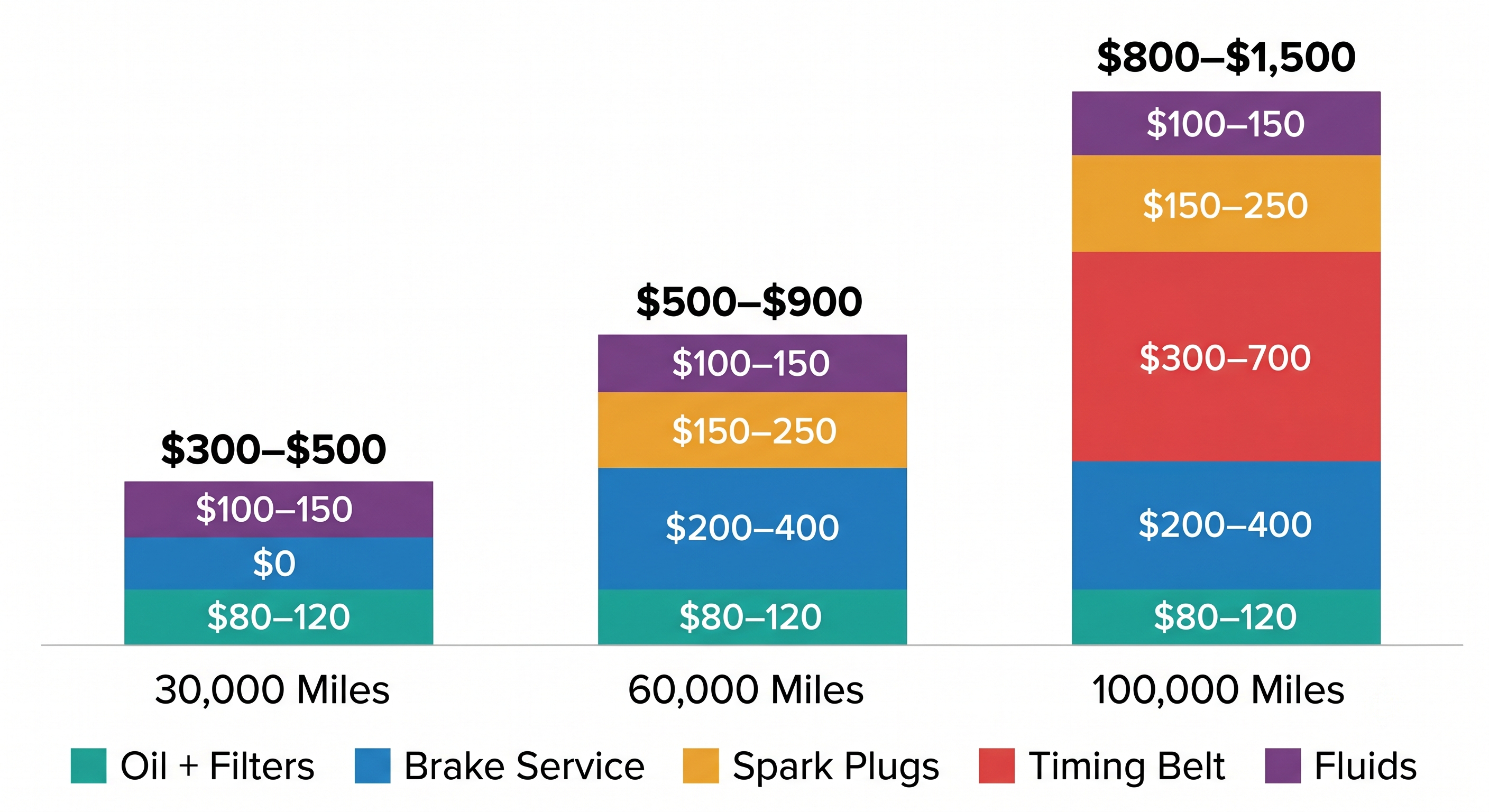
Certain mileage markers trigger larger service appointments where multiple items come due at once. Knowing what to expect at each milestone prevents sticker shock at the service counter.
30,000-Mile Service: $300-$500
The 30K service is the first major checkpoint. Everything from the routine schedule comes due, plus items that are on a 30,000-mile cycle:
- Oil and filter change
- Tire rotation and balance
- Engine air filter replacement ($83 average)
- Cabin air filter replacement ($95 average)
- Brake inspection — measure pad thickness and rotor condition
- Fluid check: coolant, brake fluid, transmission fluid, power steering fluid
- Battery terminal inspection for corrosion
- Belt and hose visual inspection
Toyota, Subaru, and Hyundai add a first transmission fluid change here under severe schedules. Toyota does not require it at 30,000 under normal conditions, but does under severe. Honda's Maintenance Minder triggers code 3 (transmission fluid) based on driving patterns, not fixed mileage.
60,000-Mile Service: $500-$900
The 60K service is the most important milestone in the first 100,000 miles. Four to six wear items hit their replacement window simultaneously:
- Everything in the 30K service
- Spark plug replacement: $80-$200 for a 4-cylinder, $120-$400 for a V6, $160-$500 for a V8 (Kelley Blue Book estimates)
- Brake fluid flush: $80-$150
- Transmission fluid and filter change: $150-$250
- Serpentine belt inspection (replace if cracked or glazed): $100-$200
- Timing belt inspection on interference engines — Subaru and Honda call for replacement at 60,000-105,000 miles depending on model; Toyota and Hyundai typically spec 90,000-100,000 miles
The 60,000-mile service is where skipping maintenance gets expensive. A transmission fluid change at 60,000 miles costs $150-$250. A transmission rebuild because you ran the original fluid to 150,000 miles costs $3,000-$5,000. Spark plugs are $80-$300 at 60K. A misfiring engine that damages the catalytic converter costs $2,164-$2,483 (RepairPal average) to fix.
100,000-Mile Service: $800-$1,500
At 100K, you're into major component territory. Items that were designed to last the "first life" of the vehicle are reaching their limits:
- Everything in the 60K service
- Timing belt replacement (if equipped): $884-$1,284 including the water pump, which is typically replaced at the same time since it's behind the same cover
- Coolant flush: $131-$209
- Spark plug replacement (if on a 100K cycle — iridium and platinum plugs)
- Suspension component inspection: shocks, struts, control arm bushings, tie rod ends
- Power steering fluid change
- Second or third set of brake pads: $150-$300 per axle at an independent shop
Vehicles past 100,000 miles also start showing age-related issues that aren't on any maintenance schedule — rubber seals dry out, gaskets weep, and electrical connectors corrode. Budget $1,200-$1,800 per year for maintenance and repairs once you pass this mark.
Services That Are Frequently Upsold
Not every service a shop recommends is in your owner's manual. Three services are commonly pushed as maintenance items but are rarely manufacturer-recommended:
Engine flush ($100-$150). Manufacturers do not recommend engine flushes on engines that have been maintained with regular oil changes. Engine flushes can dislodge sludge deposits and block oil passages, potentially causing engine damage. If your engine has sludge problems, the solution is more frequent oil changes — not a chemical flush.
Fuel injector cleaning ($150-$200). American Honda explicitly states that fuel injector cleaning is "an unnecessary maintenance procedure." Modern Top Tier gasoline contains detergents that keep injectors clean. Unless you're experiencing specific symptoms — rough idle, hesitation, a misfire code — this service is not needed.
Transmission flush ($200-$400). Different from a transmission fluid change. A flush forces fluid through the system under pressure, which can push debris into valve bodies and damage tight-tolerance components. Honda, Toyota, and Nissan recommend against flush machines. A standard drain-and-fill is the correct service for transmission fluid.
The rule: if it's not in your owner's manual, you don't need it. Shops mark these services up 200-400% over cost, which is why they push them.
How Much Does Car Maintenance Cost Per Year?
The BLS Motor Vehicle Maintenance and Repair price index rose 43.6% from January 2019 to January 2025 — roughly double the rate of general inflation. Maintenance is getting more expensive, but the costs are still far cheaper than the repairs you avoid.
| Vehicle Age | Annual Maintenance Cost | What Drives the Cost |
|---|---|---|
| 0-3 years | $500-$800 | Oil changes, tire rotations, filters, inspections |
| 3-5 years | $800-$1,200 | Brakes, first set of tires, battery |
| 5-8 years | $1,200-$1,600 | Spark plugs, transmission fluid, suspension wear |
| 8-10+ years | $1,500-$2,000+ | Timing belt, water pump, major component replacement |
AAA's 2025 Your Driving Costs study breaks down maintenance, repair, and tire costs at 11.04 cents per mile across all vehicle types. By category: small sedans cost 10.23 cents/mile, compact SUVs cost 11.64 cents/mile, and half-ton pickups cost 11.36 cents/mile. Hybrids are cheapest at 9.75 cents/mile. At 15,000 miles per year, that's $1,463 for a small sedan and $1,746 for a compact SUV.
A well-maintained car costs roughly $900 per year in maintenance for the first five years (AAA, 2025). Skipping maintenance doesn't save that $900 — it converts it into $3,000-$8,000 repair bills when engines, transmissions, or brake systems fail prematurely. Every dollar spent on scheduled maintenance returns $3-$5 in avoided repairs.
Check for Safety Recalls
NHTSA issued recalls affecting 27.7 million vehicles in 2024 alone. Electrical systems were the most recalled component at 6.3 million vehicles. Recall repairs are free at any authorized dealer — the manufacturer pays for parts and labor.
Check your vehicle's recall status at nhtsa.gov/recalls using your VIN. Pinion also monitors NHTSA recall data and sends a push notification if a recall is issued for your specific vehicle based on your VIN.
Common recall categories that overlap with maintenance:
- Brake system recalls — leaking brake fluid lines, defective master cylinders, or ABS module failures
- Fuel system recalls — fuel line connections, fuel pump failures, fuel tank issues
- Electrical recalls — battery management, wiring harness faults, software updates affecting engine control
A recall is not the same as a maintenance item, but checking for open recalls should be part of every service visit.
How to Read Your Owner's Manual Maintenance Section
Your owner's manual is a 300-400 page book, but the maintenance schedule section is usually 5-10 pages. Here's how to find what you need:
- Find the maintenance schedule chapter — typically in the back third of the manual, usually labeled "Maintenance" or "Service and Maintenance"
- Identify which schedule applies — look for "Normal" and "Severe" (or "Special Operating Conditions") sections
- Read the severe criteria honestly — if any single condition applies to your typical driving, use the severe schedule
- Note the fluid specifications — your manual lists exact oil viscosity (0W-20, 5W-30), transmission fluid type, and coolant type. Using the wrong spec voids the protection those fluids provide
- Check for model-specific items — turbo engines, AWD systems, and towing packages typically have additional maintenance requirements not on the base schedule
If you've lost your manual, every manufacturer publishes digital versions on their website. Search "[make] [model] [year] owner's manual PDF."
Building Your Own Maintenance Timeline
Take the manufacturer's schedule and map it against your actual driving. If you drive 12,000 miles per year on the normal schedule with 10,000-mile oil change intervals, your first three years look like this:
| Mileage | Services Due | Estimated Cost |
|---|---|---|
| 10,000 | Oil change, tire rotation | $90-$175 |
| 15,000 | Cabin air filter | $95 |
| 20,000 | Oil change, tire rotation, brake inspection | $115-$200 |
| 24,000 | Engine air filter | $83 |
| 30,000 | Oil change, tire rotation, all filters, fluid check, brake inspection | $300-$500 |
| 36,000 | Oil change, tire rotation | $90-$175 |
Year one total: roughly $370-$550. Year two: $300-$480. Year three (30K service): $500-$700.
Pinion builds this timeline automatically from your VIN. It pulls your manufacturer's maintenance schedule, factors in your reported mileage, and sends push reminders before each service is due. It also logs every service with cost tracking, so you can see exactly what you've spent per year and per service type.
What to Skip, What to Never Skip
Never skip:
- Oil changes — engine failure ($3,000-$8,000+)
- Tire rotations — premature tire replacement ($600-$1,200 for a set)
- Brake inspections — worn pads destroy rotors, turning a $300 job into $600-$1,200
- Timing belt (if equipped) — a snapped timing belt on an interference engine destroys the engine
Safe to push slightly (not indefinitely):
- Cabin air filter — affects HVAC airflow and smell, not mechanical function
- Windshield wipers — obvious when they need replacement
- Wheel alignment — unless you're seeing uneven tire wear or pulling
Skip entirely (unless you're experiencing symptoms):
- Engine flush
- Fuel injector cleaning
- Transmission flush (do a drain-and-fill instead at the scheduled interval)
- "BG" or "Valvoline" branded additive services — these are dealer profit centers, not manufacturer-recommended maintenance
For the services that matter most — oil changes, brake work, and fluid changes — a $200 service today prevents a $2,000-$5,000 repair next year. The maintenance schedule exists because engineers calculated exactly when each component needs attention. Follow it.
Frequently Asked Questions
Vlad Kuzin
Developer of Pinion. Writes about car maintenance to help people save money and stay safe on the road.